How Much Does Tree Removal Cost in Omaha?
Tree-removal cost in Omaha depends on much more than the tree’s height. Its condition, location, available drop zone, equipment access, nearby structures, power lines, debris volume, stump work, and urgency can all change the estimate. The most useful price is therefore one based on the actual tree and property—not a broad online average.
At Midwest Roots Tree Services, we believe homeowners should understand what they are paying for. An estimate should not feel like a mystery number attached to a tree. It should explain the work required to complete the project responsibly.
This guide breaks down the factors behind an Omaha tree-removal estimate, the questions worth asking, and the details to compare before hiring a tree service. You can also review our Omaha tree-removal services for the site-specific approach to access, targets, and removal options.
Why There Is No Honest One-Price Answer
Two trees of approximately the same height can require completely different removal plans.
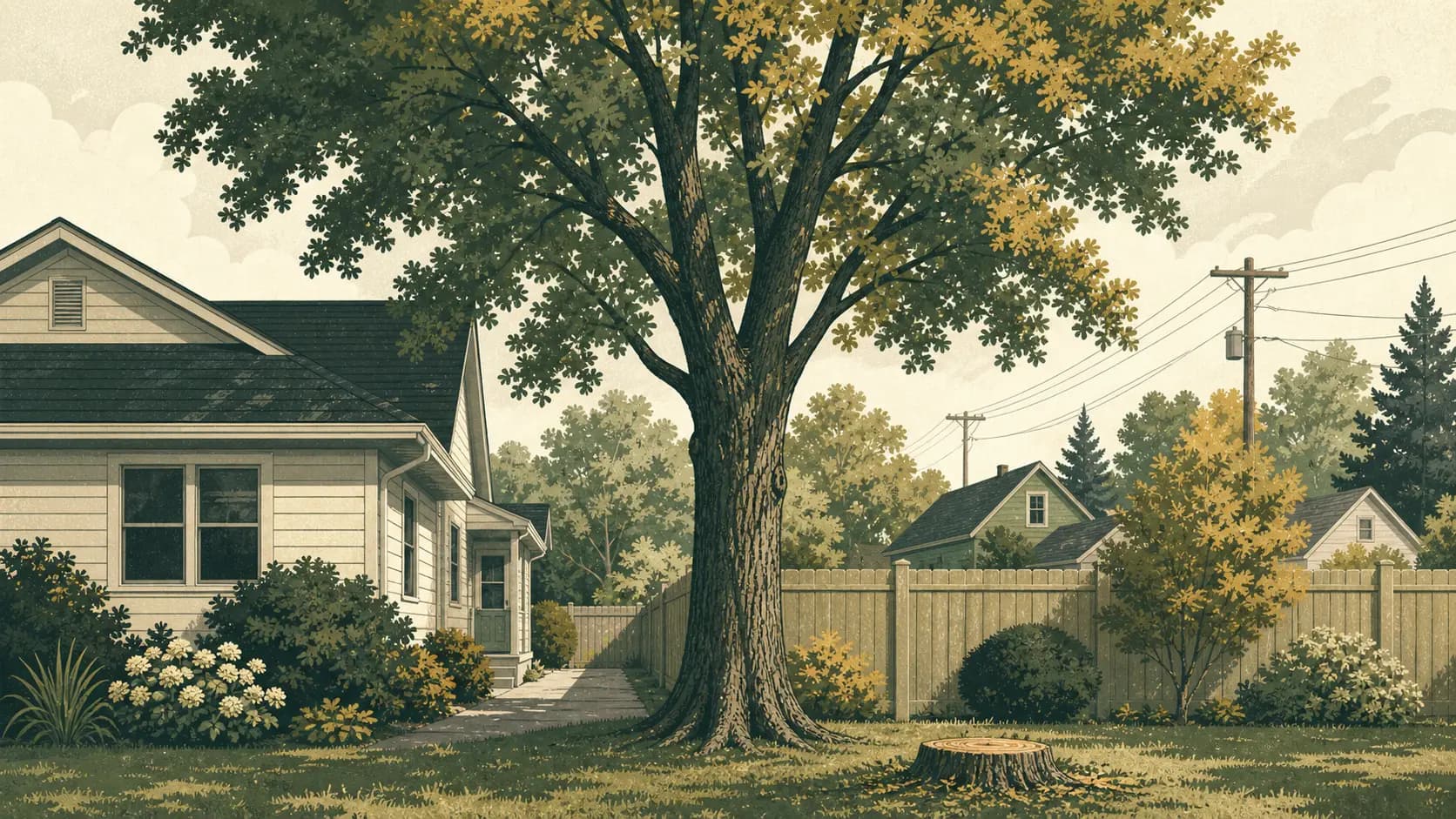
One may stand in an open front yard with enough room to lower or drop material efficiently. The other may be behind a house, surrounded by fencing, landscaping, utility lines, and neighboring property. Although they appear similar from the street, the second tree may require more workers, smaller cuts, additional rigging, and considerably more material handling.
That is why a broad online price range can be misleading. It may help with early budgeting, but it cannot account for the conditions on your property.
A preliminary cost-planning tool can help you identify the variables that may affect your project. A final estimate should be based on a direct review of the tree, its surroundings, and the requested scope of work.
Typical Tree Removal Cost Ranges in Omaha
These are our broad 2025 planning ranges, not quotes. A typical Midwest Roots tree removal runs around $1,500, and most jobs fall between $900–$2,200, driven mainly by the tree's height and how accessible it is.
| Tree height | Typical range | What tends to drive it |
|---|---|---|
| Small — under 25 ft (ornamentals, small evergreens) | $350–$780 | Simple ground-level cuts, minimal material |
| Medium — about 25–45 ft | $820–$1,330 | Moderate canopy, some rigging and lowering |
| Large — about 45–65 ft | $1,040–$1,740 | Heavier limbs, more rigging, larger crew |
| Very large — about 65 ft and up | $1,260–$2,160 | Sectional removal near targets, specialized equipment |
What You Are Actually Paying For
Tree removal is not simply the moment when a trunk is cut.
Depending on the project, the work may include:
- Evaluating the tree and surrounding work area
- Planning how branches and trunk sections will be controlled
- Protecting nearby structures and landscaping
- Establishing a work zone
- Climbing the tree or using an aerial lift
- Rigging and lowering individual sections
- Cutting and moving logs
- Chipping branches
- Loading and hauling material
- Raking and cleaning the work area
- Grinding the stump when included in the scope
Tree-care operations expose workers to hazards such as falls, falling objects, equipment injuries, unstable wood, and energized power lines. OSHA advises tree-care employers to assess both the tree and the worksite before operations begin.
Source: OSHA: Inspection Guidance for Tree Care and Tree Removal Operations
A responsible estimate accounts for the crew, equipment, planning, transportation, material handling, and cleanup needed for the complete project.
Eight Factors That Change a Tree-Removal Estimate
1. Tree Size and Amount of Material
Height is one factor, but it is not the only measurement that matters.
The estimator may also consider:
- Trunk diameter
- Number and size of major leaders
- Width and density of the canopy
- Number of large limbs
- Approximate volume of brush and wood
- Weight of individual sections
- Whether the trunk forks into multiple stems
A tall, narrow tree may produce less material than a shorter tree with a broad, heavy canopy. A mature tree with several large leaders can also require more individual cuts and lowering operations.
The estimate reflects not only how much tree is standing, but how much material must be controlled, processed, and removed. The common Omaha tree species guide can help with preliminary identification.
2. Tree Condition and Structural Stability
It is tempting to assume that a dead tree should always cost less because the wood is no longer alive. In practice, poor condition can make the work more complicated.
Dead, decayed, cracked, hollow, storm-damaged, or partially uprooted trees may be less predictable. An estimator may need to consider whether the trunk and limbs can support a climber, whether an aerial lift is necessary, and whether conventional rigging methods are appropriate.
Emerald ash borer-killed ash are now common across Omaha. After EAB was confirmed locally in 2016, the City identified nearly 15,000 public ash trees for removal under a ten-year plan and had removed more than 9,000 of them by January 2024. Dead, brittle ash are often less predictable than a live tree of the same size and can require more careful, costlier rigging.
Source: City of Omaha Parks and Recreation — Emerald Ash Borer (EAB)
Visible concerns may include:
- Major cracks
- Hanging or broken limbs
- Cavities
- Fungal growth near the base
- Loose bark
- Root-plate movement
- A sudden lean
- Weak unions between major stems
Condition does not automatically determine whether a tree should be removed. It does influence how the tree can be approached and what equipment may be required.
A remote photograph can help begin the conversation, but it cannot reveal every internal or underground defect. The preliminary tree-hazard screening tool can help homeowners organize visible concerns before a conversation.
3. Location and Available Drop Zone
An open drop zone gives the crew more options. A restricted work area requires tighter control.
Common obstacles include:
- Houses and garages
- Fences
- Decks and patios
- Play equipment
- Sheds
- Neighboring property
- Streets and sidewalks
- Gardens and ornamental landscaping
- Service lines
- Air-conditioning equipment
When branches cannot be allowed to fall freely, they may need to be removed in smaller sections and lowered with ropes or other rigging equipment.
This is one reason a backyard tree can cost more to remove than a similar tree in an open front yard.
4. Equipment and Backyard Access
Access affects which tools can reach the tree and how efficiently material can leave the work area.
An estimator may look at:
- Gate width
- Fence placement
- Slope
- Steps and retaining walls
- Soft or saturated ground
- Narrow side yards
- Overhead clearance
- Septic systems or underground features
- Distance from the tree to the chipper or truck
When larger equipment cannot reach the work area, more of the project may need to be completed through climbing, rigging, and manual hauling.
A long carry from the backyard to the street also adds labor. Every branch and log still has to move from the tree to the processing or loading area.
Before requesting an estimate, it helps to photograph the tree, its base, nearby structures, the route from the street, and the narrowest access point.
5. Power Lines and Other Utilities
Trees near electrical lines require special attention.
OPPD trims trees around certain distribution lines to support public safety and electric reliability, but responsibility depends on the type of line and the particular situation. Midwest Roots routing policy: For nearby or uncertain lines, pause the work and ask Midwest Roots to review the situation. You do not need to decide line ownership, voltage, clearance, or whether OPPD is needed. If the tree or branches appear to touch a line, stay clear and do not attempt the work. Midwest Roots reviews the situation and determines whether utility coordination is required. For a downed wire, arcing, or fire, stay clear and report the electrical condition to OPPD. Call 911 for fire or an immediate threat to people. Do not approach the tree, wire, or anything touching it.
Source: OPPD: Distribution Lines and Trees FAQ
Do not assume that every wire running to or past a property is handled the same way.
OSHA states that unqualified workers must maintain required clearance from energized overhead lines, beginning at 10 feet for lines at 50 kilovolts or below. Specialized line-clearance work requires appropriately trained workers and procedures.
Source: OSHA: Line-Clearance Tree-Trimming Operations
The presence of service drops, communication lines, transformers, buried utilities, or irrigation systems can also affect the work plan.
6. Debris, Wood, and Cleanup Preferences
“Remove the tree” does not mean exactly the same thing in every estimate.
A removal price might include:
- Chipping all brush
- Hauling all logs
- Removing wood chips
- Raking the work area
- Cutting firewood-length sections
- Leaving usable wood onsite
Or the price may cover only the main removal, with hauling or cleanup priced separately.
Neither structure is automatically wrong. The important point is that you know what is included.
Ask what will happen to:
- Branches
- Logs
- Wood chips
- Sawdust
- Small twigs
- Existing storm debris
- Material on the opposite side of a fence
Keeping logs or chips onsite may reduce hauling, but only when you genuinely have a use and suitable place for them.
7. Stump Grinding and Surface Roots
Tree removal and stump grinding are usually treated as separate parts of a project.
Removing the tree generally means taking down the material above the stump. Grinding uses specialized equipment to reduce the stump below the surrounding grade.
Before accepting stump work, clarify:
- Whether grinding is included
- Approximate grinding depth
- Whether visible surface roots are included
- Whether grindings will be removed or left onsite
- Whether the hole will be backfilled
- Whether topsoil and seeding are included
- Whether equipment can reach the stump
The future use of the space matters. Preparing an area for grass is different from preparing it for construction, paving, or another tree.
Underground utilities must also be considered before grinding or excavation.
8. Emergency Conditions and Scheduling
Urgent work can require a different response than planned removal.
A storm-damaged tree may involve:
- A blocked driveway or street
- A tree resting on a structure
- Suspended branches
- Partial uprooting
- Split trunks
- Utility involvement
- Work outside normal scheduling
- Additional equipment brought in quickly
Emergency conditions can also restrict the crew’s options. The safest plan may require stabilizing the area, coordinating with a utility, or waiting until another hazard has been addressed.
Not every damaged tree must be removed immediately, but people should stay clear of hanging limbs, moving root plates, split trunks, and trees contacting electrical lines.
What a Tree-Removal Price Actually Covers
A price only means something next to the work it covers.
Before you look at the total, look at what it includes. The details that change a removal price most often are:
- Stump grinding
- Log hauling
- Brush removal
- Cleanup
- Access assumptions
- Equipment selection
- Utility coordination
- Property protection
- Number of trees
- Treatment of surface roots
- Timing and scheduling
Leaving large logs onsite and hauling everything away are different jobs. So are stopping at ground level and grinding the stump, or planning around a tight backyard gate and ignoring it until the crew arrives.
A useful estimate spells out that work in writing, so the number and the job match. Midwest Roots writes every one that way.
What a Written Tree-Removal Estimate Should Include
Before approving a project, look for clear answers to these questions:
The estimate does not need to describe every cut. It should clearly identify the outcome, exclusions, and responsibilities.
Can You Reduce the Cost Without Cutting Corners?
Sometimes.
The best savings usually come from simplifying the legitimate scope rather than taking on dangerous work yourself.
Possible options include:
- Keeping suitable logs onsite
- Keeping wood chips when you have space for them
- Combining multiple planned projects
- Providing clear access before the crew arrives
- Moving patio furniture, vehicles, and loose objects
- Scheduling nonurgent work instead of requesting immediate service
- Separating stump grinding from the initial removal when appropriate
Source: OSHA: Inspection Guidance for Tree Care and Tree Removal Operations
Ask the estimator which homeowner preparations would be useful. Do not assume that a task is safe simply because it appears simple from the ground. The DIY or professional tree-work guide offers another decision aid.
Start With a Clearer Tree-Removal Plan
Tree-removal cost in Omaha is determined by the work required on your property—not by height alone.
Tree condition, available working room, access, utilities, cleanup, stump grinding, and timing all contribute to the estimate. Understanding those factors makes it easier to ask useful questions and compare proposals fairly.
Start with the Midwest Roots cost-planning tool for a preliminary look at your project. For a site-specific recommendation and written estimate, contact Midwest Roots Tree Services.
Related Tools and Services
Frequently Asked Questions
Does homeowners insurance cover tree removal?
Sometimes, but usually only when a covered event—such as a storm—causes a tree to damage an insured structure, and coverage is often capped per tree. Removing a healthy, dead, or diseased tree for maintenance or safety is typically the homeowner's own expense. Check your specific policy limits and deductible before assuming a claim will apply.
How much does it cost to remove a tree in Omaha?
There is no dependable universal price. The estimate depends on tree size, structure, condition, access, nearby targets, equipment, cleanup, stump work, and urgency. A job-specific assessment is more useful than a broad online average.
Can I get an accurate estimate from a photograph?
Photos can help with preliminary planning, especially when they show the full tree, trunk base, nearby structures, and access route. However, an onsite review may still be needed to confirm dimensions, condition, equipment access, utility conflicts, and the complete scope.
Is stump grinding included with tree removal?
No. Stump grinding is a separate service we schedule when there are several to do, not a standard part of a single-tree removal—ask us if you need it, especially if you have more than one stump. When you do compare stump-grinding quotes, check grinding depth, surface roots, debris removal, backfilling, and access.
Why is backyard tree removal often more expensive?
Backyard access may limit equipment and require more climbing, rigging, manual hauling, and property protection. Fences, roofs, landscaping, narrow gates, and long carrying distances can all increase the work involved.
Does OPPD remove trees near power lines?
OPPD responsibility depends on the line and situation. Midwest Roots routing policy: For nearby or uncertain lines, pause the work and ask Midwest Roots to review the situation. You do not need to decide line ownership, voltage, clearance, or whether OPPD is needed. If the tree or branches appear to touch a line, stay clear and do not attempt the work. Midwest Roots reviews the situation and determines whether utility coordination is required. For a downed wire, arcing, or fire, stay clear and report the electrical condition to OPPD. Call 911 for fire or an immediate threat to people. Do not approach the tree, wire, or anything touching it.
View sourceDo I need a permit to remove a tree in Omaha?
A permit is required before removing or planting a tree on a City of Omaha right-of-way or in a city park. Requirements can differ for private property, street obstructions, utility conflicts, and other special circumstances. Confirm ownership and location before beginning work.
View sourceShould I choose the lowest tree-removal quote?
Price only means something next to the scope it covers. Check what the number includes: cleanup, hauling, stump work, and how the tree comes down around structures. Midwest Roots puts all of that in the written estimate so you know exactly what you are paying for.
Does emerald ash borer make removal more expensive or urgent?
It can. Standing dead ash grow more brittle and unpredictable over time, which raises safety risk and can require more careful, sometimes costlier work. For that reason, emerald ash borer-killed trees are often a removal priority.
Can a dead tree be cheaper to remove?
Sometimes, but not always. A dead tree may contain less foliage, yet deteriorated wood can make climbing, cutting, or rigging less predictable. The effect on price depends on the tree’s actual structure, location, and available removal method.
Sources
- 01Emerald Ash Borer (EAB)City of Omaha Parks and Recreation · Accessed 2026-07-21
- 02Inspection Guidance for Tree Care and Tree Removal OperationsOccupational Safety and Health Administration · Accessed 2026-07-19
- 03Line-Clearance Tree-Trimming OperationsOccupational Safety and Health Administration · Accessed 2026-07-19
- 04Distribution Lines and Trees FAQOmaha Public Power District · Accessed 2026-07-19
- 05FAQ and Code EnforcementOmaha Municipal Code, Chapter 37 · Accessed 2026-07-21
Keep reading
This article provides general educational information. Tree condition, property access, utilities, and work requirements vary by site. A photograph or online guide cannot replace an on-site evaluation when safety or structural condition is uncertain.